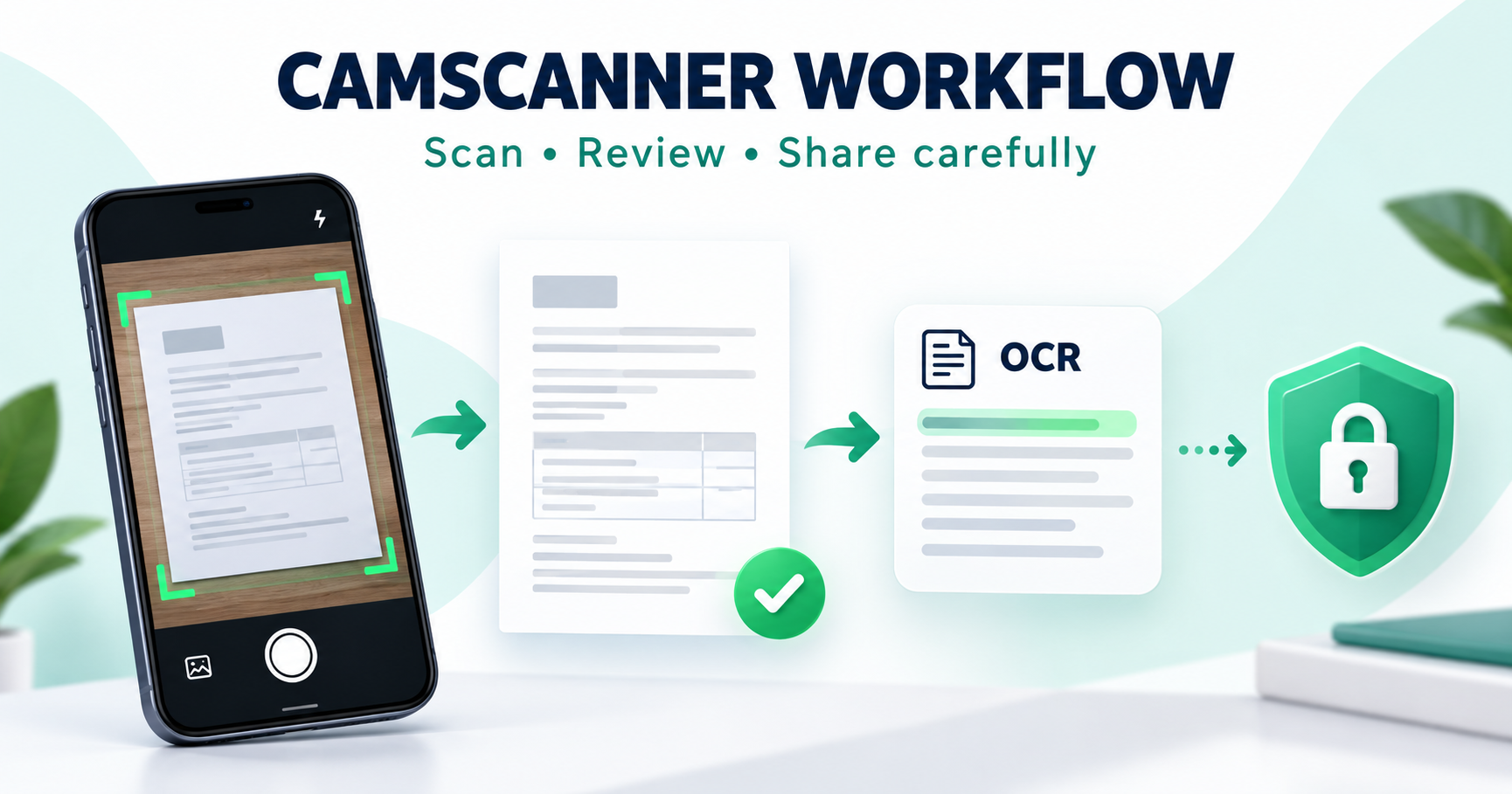
Review a scanned document before you share it. A scan that looks acceptable at thumbnail size may still contain cropped text, an incorrect page order or OCR mistakes. This guide provides a practical checking workflow for documents created with a scanning app such as CamScanner.
Start with the genuine app
For the app source and purchase-information checks, see our CamScanner official-download and privacy guide. The official store listing and publisher website describe the current app. This article does not offer a Premium-unlocked package.
Prepare the page and capture
Place the page flat with enough contrast between its edges and the background. Use even lighting, avoid glare and keep fingers out of the captured area. For a multi-page document, capture each page in the intended order. Inspect the full page rather than assuming automatic edge detection included every corner.
Check the PDF visually
Open the exported document and look for missing edges, unreadable small print, shadows, rotated pages and duplicate or missing pages. Zoom in on important text and numbers. Make sure the recipient can open the chosen format. Keep the original capture until you know the export is usable.
Treat OCR as a draft
OCR turns an image into recognised text, but recognition can introduce mistakes. Compare names, dates, amounts and reference numbers with the original. Pay particular attention to faint print, handwriting, tables and similar-looking characters. Do not treat machine-recognised text as an independently verified record.
Share only what is necessary
Before sharing a sensitive document, check the recipient, file contents and any link-access settings. Remove information that is not needed for the purpose where appropriate. Review whether a copy is stored on your device or uploaded to a service; the app’s current settings and privacy terms matter.
If export or sharing fails
Identify whether the issue is file creation, storage, a purchase prompt or the destination service. Record the error and try a small, non-sensitive sample to narrow the cause. Do not uninstall or clear data until important captures and projects have been protected.
CamScanner or Adobe Scan: compare the PDF workflow
Choose a scanner by the output and handoff you need, then inspect a sample before moving your documents. Both publishers describe document capture and text recognition. That overlap does not establish equal recognition accuracy, identical free allowances or an automatic transfer of your existing library.
| Question | CamScanner | Adobe Scan |
|---|---|---|
| Capture and reuse | The publisher’s Play listing describes scanning, OCR extraction and PDF/JPEG sharing. | Adobe describes PDF capture, OCR, JPEG output and sharing by link or email. |
| Continue on another device | The listing describes account-based cross-device document sync. | Adobe describes access to saved scans through Acrobat on desktop, web and mobile. |
| Cost to check | The listing includes ads, in-app purchases and subscriptions. Confirm the particular tool before relying on it. | Free download and scan sharing do not mean every advanced Acrobat task is free. Check the current offer for that task. |
| Before choosing | Check capture legibility, page order, recognized text, export type, account/storage rules and the recipient’s ability to open the actual file. | |
These are documented workflow differences from the CamScanner publisher listing and Adobe Scan product page, reviewed 23 October 2026. They are not results of a head-to-head accuracy test.
A useful comparison you can perform
- Use the same non-sensitive page in each app. Include the kind of material you actually handle, such as a receipt or a two-column handout.
- Keep the original capture. Record which output you selected and whether that step requested a subscription.
- Open each exported file outside the scanner. Compare page edges, rotation and small text rather than thumbnail appearance.
- Search for a distinctive word and copy a short passage where the output supports it. Compare with the paper; do not infer accuracy from the presence of searchable text.
- Send only a non-sensitive sample through the destination you intend to use. Check attachment versus link access separately.
Keep a document library and any important original captures until you have checked the destination account and exports. Installing a second scanner is not a migration procedure. For related document and app tasks, browse the Android guide directory.
Check OCR errors before sharing the document
Verify the image and the recognized text separately. A page may look right while its text layer contains a wrong number. Conversely, selectable text does not establish that every page or table was recognized in the correct order.
The Android publisher Xodo’s OCR guide distinguishes searchable, selectable and editable output. Those are different capabilities. This document-review checklist applies after recognition; it does not claim that all scanners use Xodo’s menus or features.
- Check completeness. Match the exported page count and sequence to the source. Check headers, footnotes and text near page borders.
- Verify critical values character by character. Review names, dates, decimal points, signs, account/reference numbers and units directly against a legible source.
- Check relationships. For tables, make sure an amount still belongs to its row and column. For multiple columns, confirm that copied paragraphs have not been interleaved.
- Test search and copy separately. Search for a word visible in the image, then copy a short passage into a temporary note. Check whether spaces, line breaks and punctuation remain understandable.
- Repair from the original. If a character cannot be read, obtain a clearer capture or ask the document’s author. Label uncertainty instead of substituting a likely answer.
- Review the version you will send. Open the final attachment, not only the editable project. If you send both an image and transcription, make clear which is the source and which has been corrected.
Can I correct copied text without changing the PDF?
Yes, a separate transcription can be corrected while the PDF remains unchanged. Do not tell a recipient that the PDF’s searchable text was repaired unless you actually checked that file. Keep version names distinct so an older uncorrected export is not sent by mistake.
What if I cannot verify a sensitive document?
Pause before sharing it. Avoid uploading private examples to unrelated public OCR sites solely to obtain a second guess. Check the service’s data-handling terms and the document owner’s requirements first. For broader access and upload decisions, use our Android permission and privacy checklist.
OCR verification section reviewed 23 October 2026. Suggested checks only; no measured recognition-accuracy result is claimed.
Frequently asked questions
Does a clear image guarantee accurate OCR?
No. Compare the extracted text with the source document.
Should I delete the original immediately after export?
First verify the exported pages and keep any original needed for your records.
Are all tools free?
Check the current app and store purchase information. This workflow does not promise free access to every feature.
Did you test a specific CamScanner release?
No. These are general document-review steps, not a hands-on app test.
Sources and review scope
Reviewed 15 October 2026. App identity and source information are based on the linked publisher and store pages. The checking workflow is general guidance. See APK source and permission checks before considering an unfamiliar installation file.