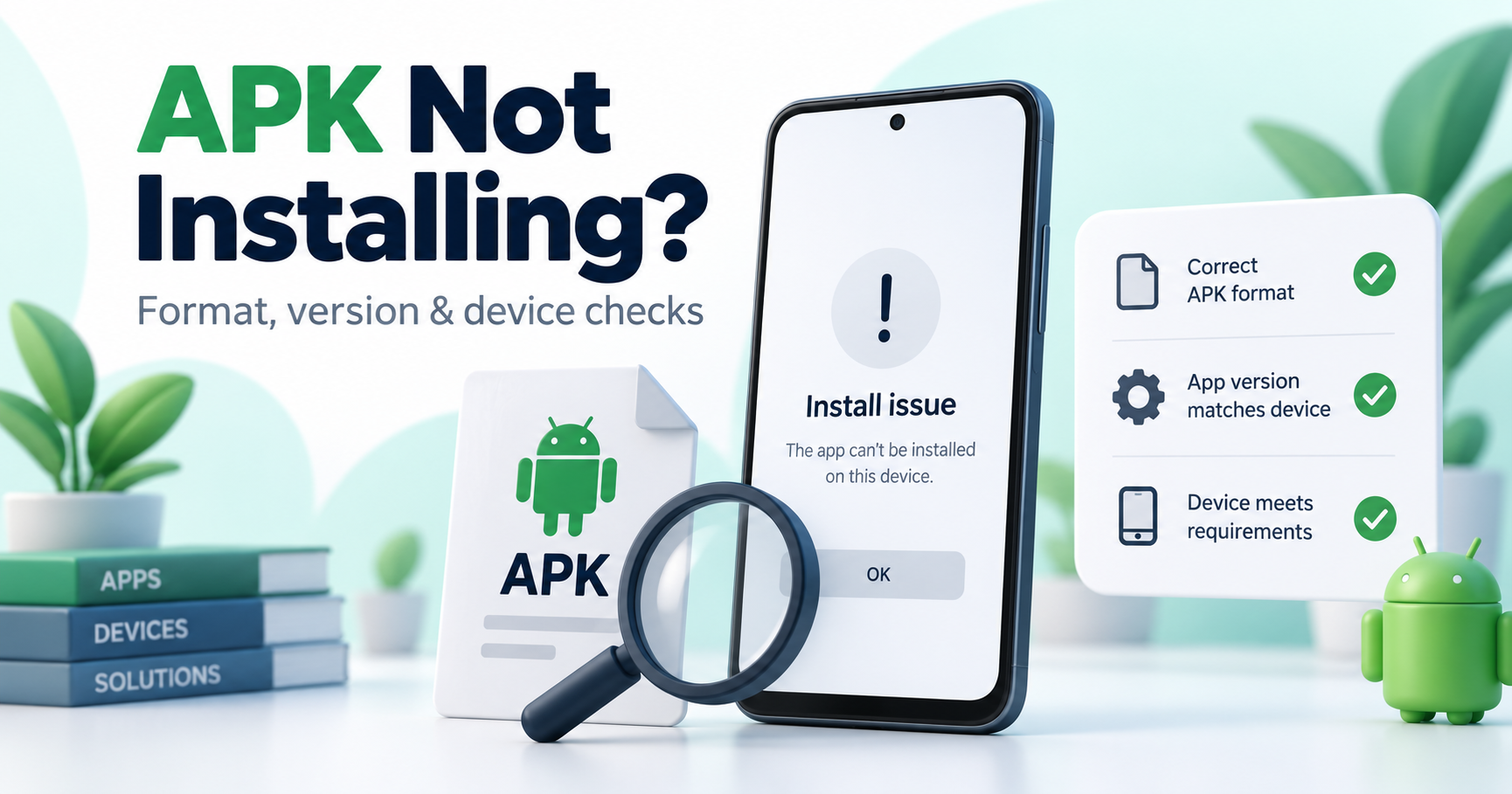
APK not installing on Android? Common causes include an incomplete download, unsupported Android version, missing split APKs, insufficient storage, an update-signature conflict or installation restrictions. Start with the exact error message rather than changing every setting.
Updated October 14, 2026. This guide explains general Android troubleshooting. Menu names differ between devices; these steps are not a claim that every APK has been tested or is safe.
Quick checks before changing settings
- Write down the exact message shown by the installer. Note your phone model and Android version in Settings → About phone.
- Confirm that the file came from the developer or another source whose identity you can establish.
- Check that the download completed and that the release supports your device.
- Back up important app data before uninstalling an existing app or clearing its storage.
- Keep Play Protect enabled. If it identifies an app as harmful, stop rather than bypassing the warning.
Match the error to the next check
| Error or symptom | What to check first |
|---|---|
| Problem parsing package / package appears invalid | File completeness, supported Android version and package format |
| App not installed during an update | Whether the new build comes from the same publisher and has a compatible signature |
| Not enough storage | Available internal storage for installation as well as the download |
| Install from this source is not allowed | The installation permission for the browser or file manager opening the file |
| Blocked or harmful-app warning | The warning details and verified developer support |
1. Check the file and package format
An interrupted download can leave a file the installer cannot read. Download again from the verified source if the file is incomplete. Do not simply rename an archive to .apk.
Some apps are distributed as a set of split APKs. A base APK alone may not contain all required components. Google Play handles the appropriate package selection automatically; for another distribution source, follow that publisher’s documented installation method.
See Android Developers’ explanation of app bundles and split APKs.
2. Confirm Android and device compatibility
Check the release’s minimum Android version and supported hardware against your device. An older Android version, unsupported processor architecture or missing device features can prevent installation. A build that works on one phone is not necessarily suitable for another.
Use the developer’s supported release. Installing an arbitrary older version is not a reliable fix and can introduce outdated software.
3. Check installation permissions
If you trust the source and Android asks for permission, find Settings → Apps → Special app access → Install unknown apps. Choose the browser or file manager that opens the APK. This permission is separate from the installed app’s camera, contacts or storage permissions.
Device management policies and additional protections may restrict installation. Ask the device administrator or developer for support instead of disabling protections. Turn off the installation permission afterwards if you no longer need it.
Official reference: Google’s Android app installation guidance.
4. Resolve an update conflict without losing data
If an app is already installed, a package signed by a different publisher may not be accepted as an update. Confirm that both releases come from the same verified source. Android app signing helps establish the identity of an update.
Do not uninstall the current app as your first step: local data may be lost. Check backup and recovery options, then ask the publisher for a compatible update. See Android app signing documentation.
5. Free storage and restart
Installation can require more space than the downloaded file. Check internal storage, remove files you no longer need after backing them up, and restart the phone. Clearing an app’s data removes more than its cache and should not be used as a routine first step.
When to stop and ask for help
Keep Google Play Protect enabled. If an APK is flagged as harmful, its source cannot be established or the developer’s requirements are unclear, do not force installation. A scanner result alone does not guarantee safety.
For continuing errors, send the developer your device model, Android version, release identifier and exact error text. Avoid sending passwords or private app data.
Frequently asked questions
Why does my phone say “app not installed”?
This is a general failure message. Check file completeness, device compatibility, storage, installation policy and whether the APK is updating an existing app.
Can I fix an invalid package by renaming it?
No. Changing a filename does not repair an incomplete package or supply missing split APKs.
Should I disable Play Protect?
No. Read the warning and verify the app with its developer. Disabling the check does not establish that the app is safe.
Do I need to factory reset my phone?
A factory reset is not an appropriate first step for one APK installation problem. Check the file and supported release first, and contact device support if broader system problems persist.
Related Android guides
For app-specific troubleshooting, read our RTS TV installation and playback guide. You can also report an outdated instruction.